Open Call for Netherlands-based Composers
Introduction of the Open Call
How might a story told in sound change when it unfolds around the listener?
Futures of Listening (FoL) and the Immersive Audio Network (IAN) announce a joint open call for a composer / sound practitioner registered in the Netherlands to develop and present work at the IAN Festival on 29 January 2027 at Arnolfini, Bristol (UK).
The residency lasts 5 days between 22 to 27 January and includes a two-day introductory course in immersive audio followed by three days of studio work in IAN’s mobile Immersive Audio Lab, concluding with a public work-in-progress presentation at the festival on 29 January. All activities take place in Bristol.
The call is open until 21 November 2026, 23:59 CET.
Research focus
The residency is particularly suited to developing an existing project into a new format, experience or perspective, rethinking it through the research questions below and the spatial sound infrastructure of the Lab. We are especially interested in projects that integrate narrative and storytelling techniques and engage with one or more of the following questions:
- If you begin with sound, what new kinds of stories become possible?
- How can sonic stories be designed for and by multiple audiences and communities, including the non-human?
- When the whole body in relation to a space is the primary site for an immersive experience, what new forms of storytelling and meaning-making become possible?
The Immersive Audio Lab
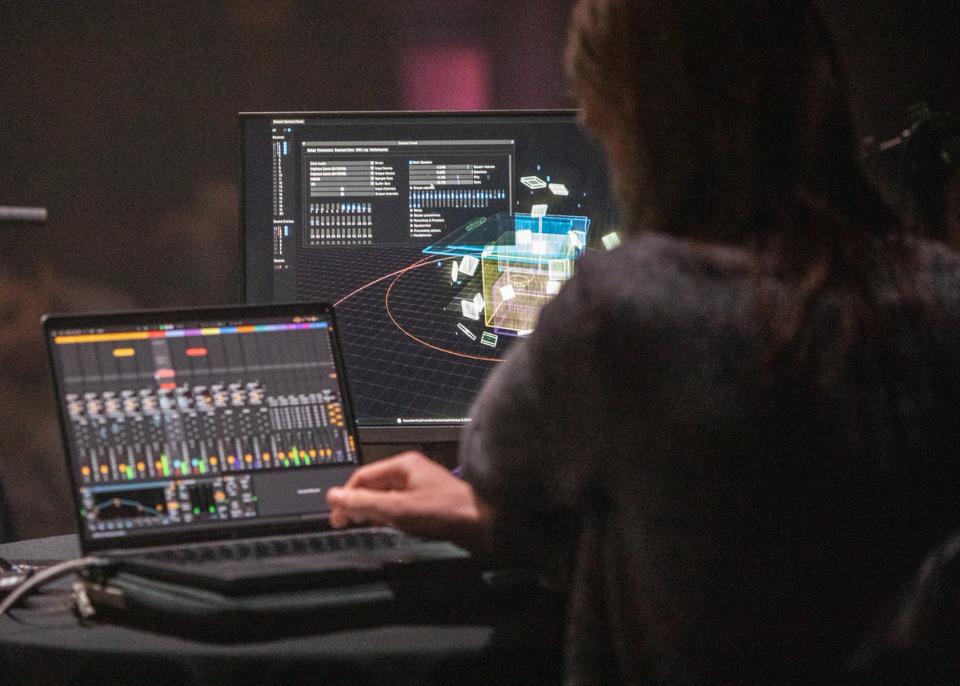
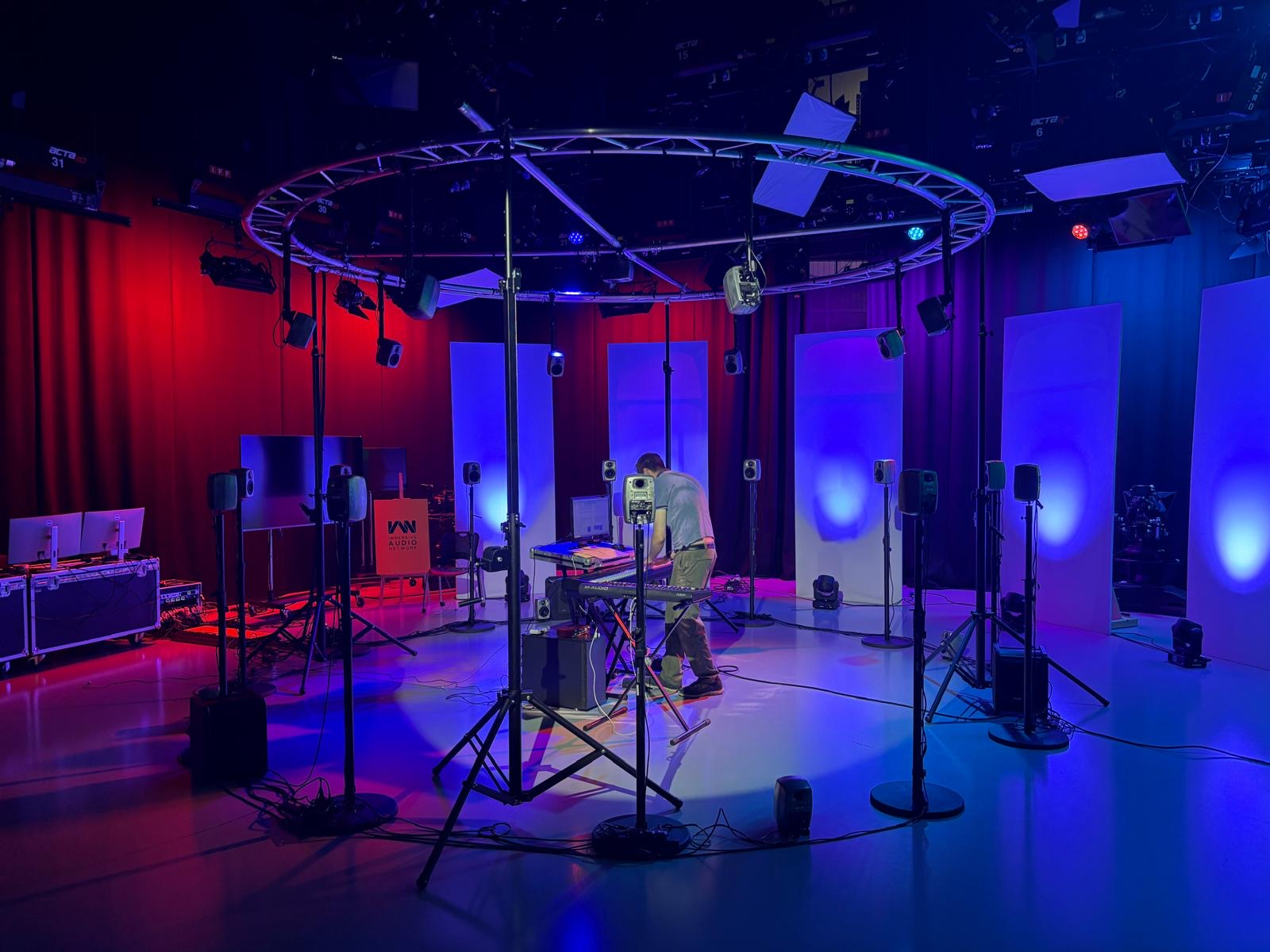
IAN’s mobile Immersive Audio Lab is a dome structure with 25 Genelec loudspeakers, 3 subwoofers and a Mac with a range of spatial audio software. The loudspeaker layout can be addressed in different ways, and the system supports Dolby Atmos 9.1.6 content as well as Ambisonics up to fourth order. Besides working with the integrated computer, artists can connect their own computer and use their own software and workflows. The technical sheet listing the available hardware and software is accessible here. The technical set-up is arranged in advance on the basis of the technical information provided in the application.
Residency structure and support
Timeline and availability
3 November - Open Call
21 November 2026, 23:59 CET - Application deadline
4 December 2026 - Announcement of the selected artist
10 December 2026 - Onboarding call with the research coordinator and researchers
22 January 2027 - Travel to Bristol
23–24 January 2027 - Introductory course in immersive audio
25–27 January 2027 - Studio work in the Immersive Audio Lab, with technical support and research mentoring
28 January 2027 - Day off (festival technical production; no access to the Lab)
29 January 2027 - Work-in-progress presentation at the IAN Festival, Arnolfini
30 January 2027 - Return travel
February 2027 - Optional - Writing an article (~2000 words) for The Writing Platform, with editorial support
March 2027 - Publication of the article
Introductory course and studio work
The residency opens with a two-day introductory course in immersive audio, followed by three days of studio work in the Immersive Audio Lab with studio guidance from IAN specialists.
Research mentoring
Research for the residency is supported by author and digital media researcher Prof Kate Pullinger of the Narrative and Emerging Technologies (NET) Lab, based in the Centre for Cultural and Creative Industries at Bath Spa University, which she co-directs.
Further research mentoring is provided by Dr Angela McArthur, an artist, academic and interdisciplinary advocate. She leads a master’s programme in spatial sound in the Department of Anthropology at University College London (UCL), and is a lead researcher for Futures of Listening in a research area that enquires into the speculative futures of immersive narratives and perceptual methods, considering sonic storytelling through embodied experience.
Opportunity to Write and Publish an Article
The selected artist has an opportunity to write an editorial piece reflecting on the residency, with editorial support, for The Writing Platform, an online publication on digital transformations in publishing, reading and writing, sponsored by Bath Spa University. The piece could be written in February and published in March 2027. The piece will also be published on Futures of Listening platforms.
General information
Applicant profile
The selection committee is looking for practitioners with a distinct voice in sound who want to explore how spatial audio might change their work. Proposals do not need to be finished or fully resolved: the committee is interested in where a project could go, how it engages with the research questions, and what the residency could contribute to your development.
The call is aimed at experienced audio creatives (composers, sound designers, audio makers, artists and researchers). ‘Experienced’ refers to working skill in audio rather than career stage. To make the most of the short residency, you should be comfortable working independently in a digital audio workstation (DAW), including:
- editing: cutting, arranging and cleaning up audio material
- montage: assembling material into a composition or narrative
- mixing: balancing levels, dynamics and timbre across multiple tracks
Previous experience with spatial audio is not required, and emerging artists are explicitly encouraged to apply.
Eligibility
Applicants must be registered with the Netherlands Chamber of Commerce (KvK), as the residency fee is paid on invoice. Applicants must be available to travel to Bristol on 22 January 2027 and to return on 30 January 2027. Applications are submitted in English.
Residency provision
- A residency fee of €1,750 (excl. VAT), paid on invoice
- Return travel from the Netherlands to Bristol, 22–30 January 2027
- Private accommodation for the full period
- A two-day introductory course in immersive audio
- Three days of studio work in the Immersive Audio Lab, with studio guidance from IAN specialists
- Research mentoring through the NET Lab and Futures of Listening
- A public work-in-progress presentation at the IAN Festival 2027
- Editorial support for an article reflecting on the residency, published on The Writing Platform and cross-promoted by Futures of Listening and IAN
Application and contact
Applications are submitted through the online application form before 21 November 25:59 CET.
Questions about the call can be addressed to Robin Koek, Research Coordinator, Futures of Listening: info@robinkoek.nl
Note on the use of AI
We want to hear your ideas in your own voice. What matters most is your artistic thinking, not elaborate application writing. AI tools can help to brainstorm, structure, translate or polish an application, especially for applicants whose first language is not English. What the selection committee looks for is your authorship and clarity of ideas: your perspective, your artistic reasoning and what genuinely drives your proposal. Applications in which AI has replaced rather than supported that voice are harder for the committee to evaluate meaningfully and are less likely to stand out.
Selection committee and organisers
Research
Dr Angela McArthur
Dr Angela McArthur leads an interdisciplinary (art/science) MA in spatial sound in the Department of Anthropology at University College London. Her research centres on underrepresented onto-epistemologies, ocean environments and intersecting sites of artistic practice. She works with the IKO loudspeaker and other spatial systems, and champions diversity in access and representation in sound and beyond.
meLê yamomo
meLê yamomo is Assistant Professor of New Dramaturgies, Media Cultures, Artistic Research and Decoloniality at the University of Amsterdam, and principal investigator of Re:Sound, DeCoSEAS and Sonic Entanglements. A composer, scholar and theatre-maker, he works with sonic archives and the histories they carry, moving between research and artistic practice. His publications include Sounding Modernities, and he holds the Open Ear Award and the KNAW Early Career Award.
Prof Kate Pullinger
Prof Pullinger’s recent works include the novels The Recent Dead (forthcoming 2027) and Forest Green. Her digital fiction works include the smartphone ghost story, Breathe, and the children’s title, Inanimate Alice. Honours include Canada’s Governor-General Award for Fiction and Fellowship of the Royal Society of Literature. www.katepullinger.com
Research coordination
Robin Koek
Robin Koek is a sound artist and designer, co-founder and Research Coordinator of Futures of Listening, and teacher of Studio Production in the Art of Sound department at the Royal Conservatoire The Hague. He explores listening as a relational and more-than-human practice, creating immersive environments across interactive installation and spatial sound. His research spans interspecies communication, aural heritage and environmental connection, foregrounding sound as a shared resource and opening space for other forms of attention, empathy and acoustic justice.
Technical review
Jan Meinema
Jan Meinema is Programme Leader of the MA Sound Design at Bath Spa University, where he has taught since 2005, and designs the playback systems for the Immersive Audio Network across the South West of England. A supervising sound editor, sound designer and spatial audio specialist, he focuses his creative work on story-driven sound for film, documentary and animation, and has worked for nearly two decades as a field recordist and re-recording engineer.
Organisers
Futures of Listening (NL)
Futures of Listening is a Netherlands-based platform supporting emerging developments in spatial sound, immersive experiences, performance and installation art. The initiative connects artists with a broad network of artistic, scientific and cultural partners through artistic research and presentation.
Immersive Audio Network (UK)
The Immersive Audio Network (IAN) is a platform for immersive sound practitioners, educators and enthusiasts in Bath and Bristol. Because work in the field often happens alone or in small teams, IAN creates space for knowledge exchange and new ideas through events, workshops and meet-ups, its mobile Immersive Audio Lab and the IAN Festival.
What are the technical specifications of Immersive Audio Lab?
The Immersive Audio Lab
IAN’s mobile Immersive Audio Lab is a dome structure with 25 Genelec loudspeakers, 3 subwoofers and a Mac with a range of spatial audio software. The loudspeaker layout can be addressed in different ways, and the system supports Dolby Atmos 9.1.6 content as well as Ambisonics up to fourth order. Besides working with the integrated computer, artists can connect their own computer and use their own software and workflows. A technical sheet listing the available hardware and software can be accessed here. The technical set-up is arranged in advance on the basis of the technical information provided in the application.